Back
Reading time:
A stronger Mexican peso does not benefit everyone
Exports grew by 24.6% in dollars, but only 9% in pesos. The exchange rate decides your margin. This is what you can do now.

Author
Federica Ferreira

If your company sells abroad and charges in dollars, today's exchange rate may be eroding your margin without anyone billing anyone for it.
The problem that no one names
When the peso strengthens against the dollar, the usual narrative celebrates Mexican purchasing power, trips abroad, cheaper imports.
But for a company that exports and charges in dollars, that same appreciation means something different: every dollar that enters your account is worth fewer pesos. Not because you sold less. Not because you negotiated poorly. But because the market moved the exchange rate before you could decide what to do with your money.
The data says it all: in the first half of 2026, Mexican exports grew 24.6% measured in dollars. In pesos, that progress was only 9.0%. The difference — 15.6 points — was decided by the exchange rate.
The real problem is not the exchange rate.
It is when you are forced to convert.
Most exporting companies do not have a sales problem. They have an infrastructure problem.
They work like this: they charge in dollars, the dollars arrive in an account that is not designed to hold them, and because they have payroll on Friday and suppliers to pay the following week, they convert when they can, not when it is convenient.
The exchange rate of the day you need pesos defines your margin. Not the price you negotiated with your buyer. Not the efficiency of your operation. Your company's payment schedule.
That is what it costs to operate with a financial infrastructure that was not designed to cross borders.
What can you do today?
There are concrete actions that companies in the corridor can take now and not when the dollar rebounds, because the institutional consensus does not anticipate a quick recovery. The median forecast of the Citi Survey places the close of 2026 at 17.68 pesos per dollar; banks like Barclays (17.00) and Morgan Stanley (17.15) are even more conservative. For 2027 the correction arrives, but gradually and starting from mid-year.
The next 90 days are the time to act.
Negotiate a fixed exchange rate with your buyers. If you invoice in dollars, consider including an exchange rate adjustment clause in your contract or setting the price in pesos for markets where you have negotiating power.
Seek to diversify your markets. A customer base in different geographies and currencies reduces exposure to a single currency pair.
Separate the decision of when to collect from when to convert. You don't have to convert the same day you receive the payment. Keeping dollars available while you cover your operation in pesos gives you margin to wait for a more favorable moment.
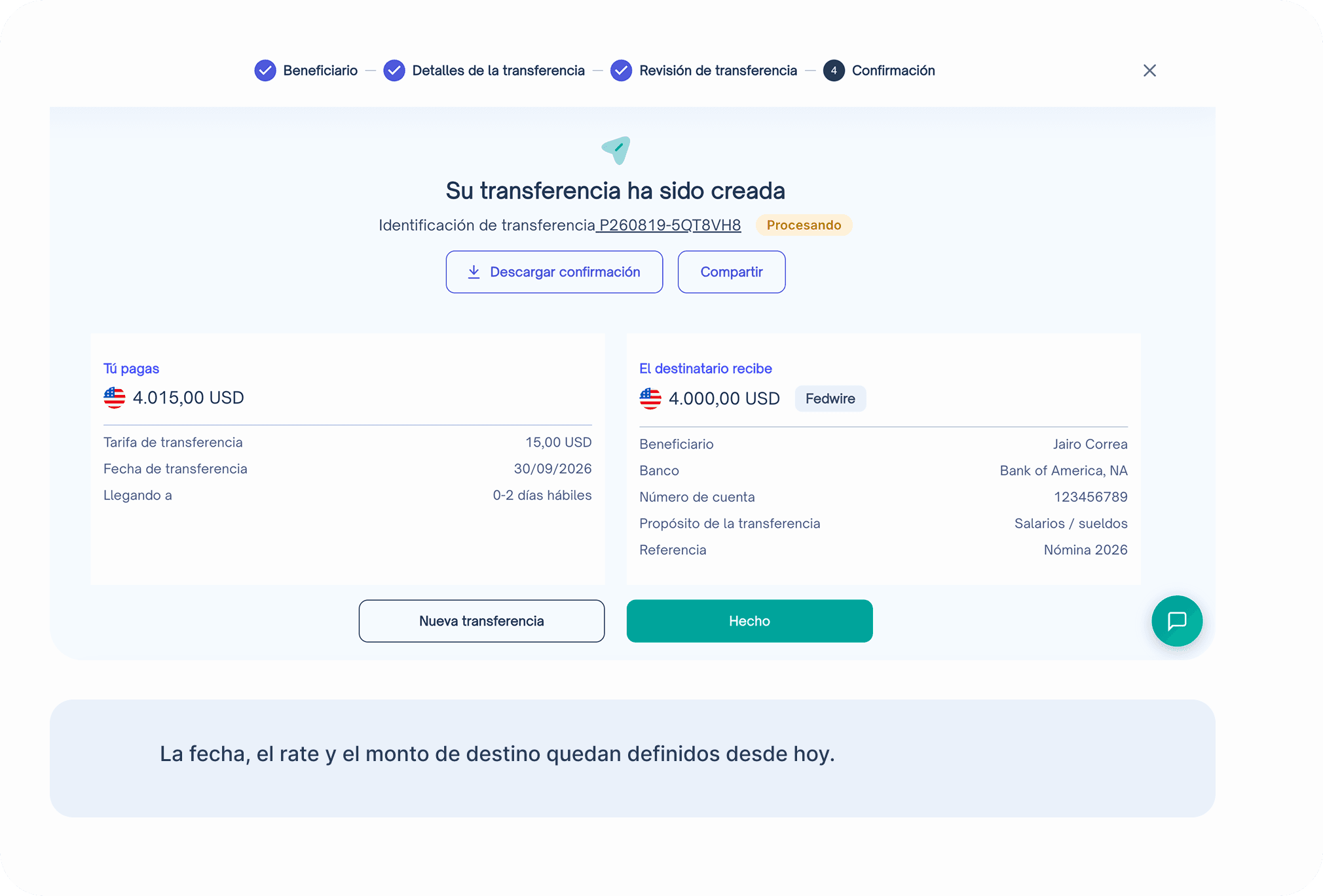
Fix the exchange rate before the date arrives. If you have a payment scheduled for the future, you can lock in the exchange rate at which it will be executed today. The amount you are going to receive is confirmed before the market moves — that is called lock rate, and it is available on the Marco platform within Transfers.
What changes when you have the right tools and infrastructure?
Marco is built for companies operating between Latin America and the United States, as the system that connects your multi-currency account, your FX, and your liquidity in one place.
That changes the exchange rate equation in a concrete way:
Hold your dollars until the time is right. Marco's Global Account allows you to receive, hold, and move USD without the pressure of converting today.
Cover your operation in pesos without touching your dollars. The Revolving Credit is evaluated on your actual operation within the platform.
If this week's exchange rate does not suit you, you can cover your operating cycle in pesos, payroll, suppliers, local expenses; and pay interest only on what you use, while you decide when to convert.
Fix the exchange rate in advance. Schedule the transfer and lock in the exchange rate starting today. Available in Transfers → Lock Rate.
It is not a financial trick.
It is power.
Most exporting companies do not have tools to decide when to convert. They have tools to convert as soon as possible and hope the exchange rate does not move too much.
That is not an FX strategy. It is an absence of options.
Marco does not tell you when the dollar is going to go up. Nobody knows. What it can do is give you the infrastructure so that the decision is yours, not dictated by the urgency of a Friday payroll.
If this mismatch sounds familiar, let's talk.
Sources:
H1 2026 Exports (+24.6% USD / +9% MXN): El Informador, Aug 22, 2026
Strongest peso since 2024 / appreciation factors: Bloomberg Línea
Impact on exporters / dollar below 17: El CEO
Citi Forecast (17.68), Barclays (17.00), Morgan Stanley (17.15): Citi Survey August 2026
Article written by
Federica Ferreira

Operate between Latin America and the U.S. from a single place.
Global Account · FX · Payments · Credit