Volver
Tiempo de lectura
The Hidden Cost of Selling Produce into the U.S.: Payroll, FX, and Cash-Flow Gaps
Collecting in USD while paying payroll in MXN is a structural problem — not a cash flow problem. Most produce exporters discover the difference too late.

Autor
Federico Peselewitz | Director of Risk

When your customers pay in 45 days but your payroll runs every Friday, something has to give.
The deal looks perfect. The timing never is.
Getting shelf space at Costco, Whole Foods, or Sprouts is a real achievement. Volume contracts with top U.S. retailers mean consistent demand, predictable revenues, and a clear path to growth.
But behind every successful produce shipment from Mexico to the U.S. is a financial timing problem that rarely makes it into the pitch deck.
Your buyers pay in 45 to 60 days. Your agricultural payroll runs every single Friday. The gap between those two realities is where most produce exporters quietly absorb costs they never fully account for — and occasionally, where operations break down entirely.
The three layers of the problem
This isn't one problem. It's three, stacked on top of each other.
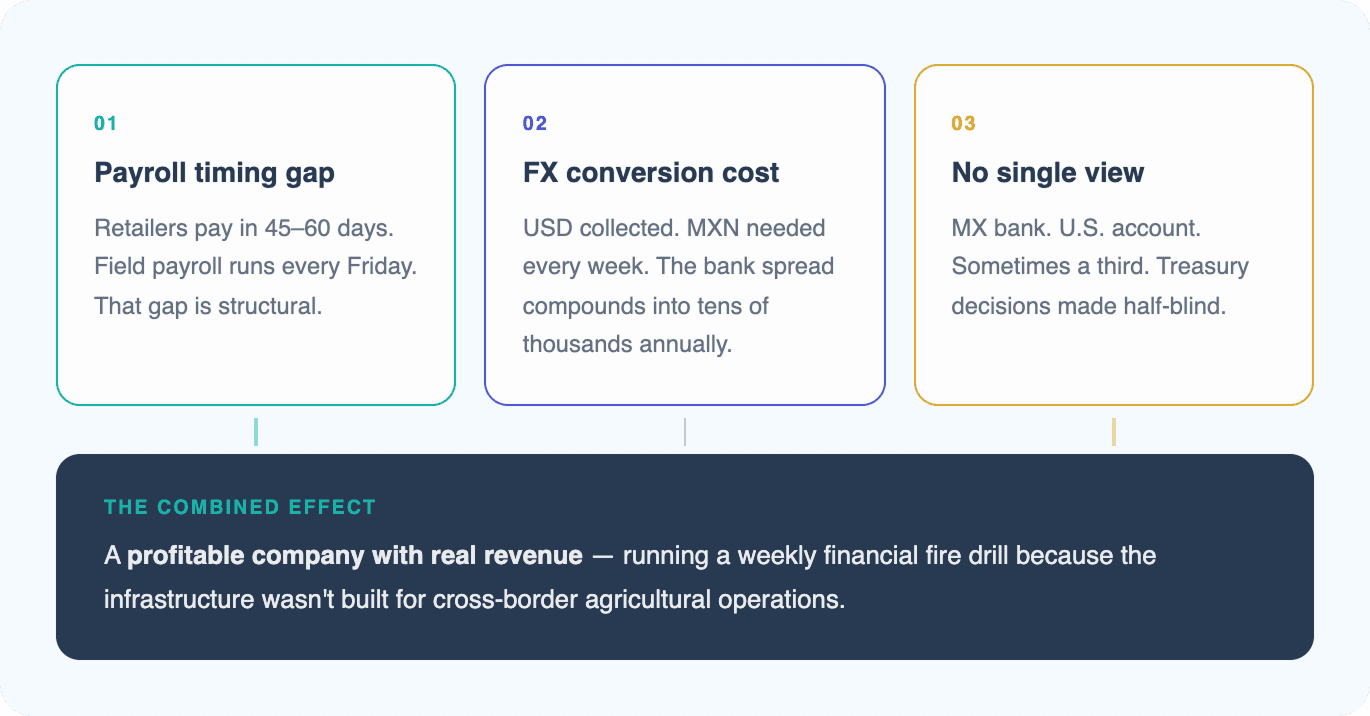
What this looks like in practice
Consider a produce exporter selling approximately USD 12M annually to retailers including Costco, Whole Foods, and Sprouts. Shipments go out weekly. Payment terms run 45–60 days across accounts.
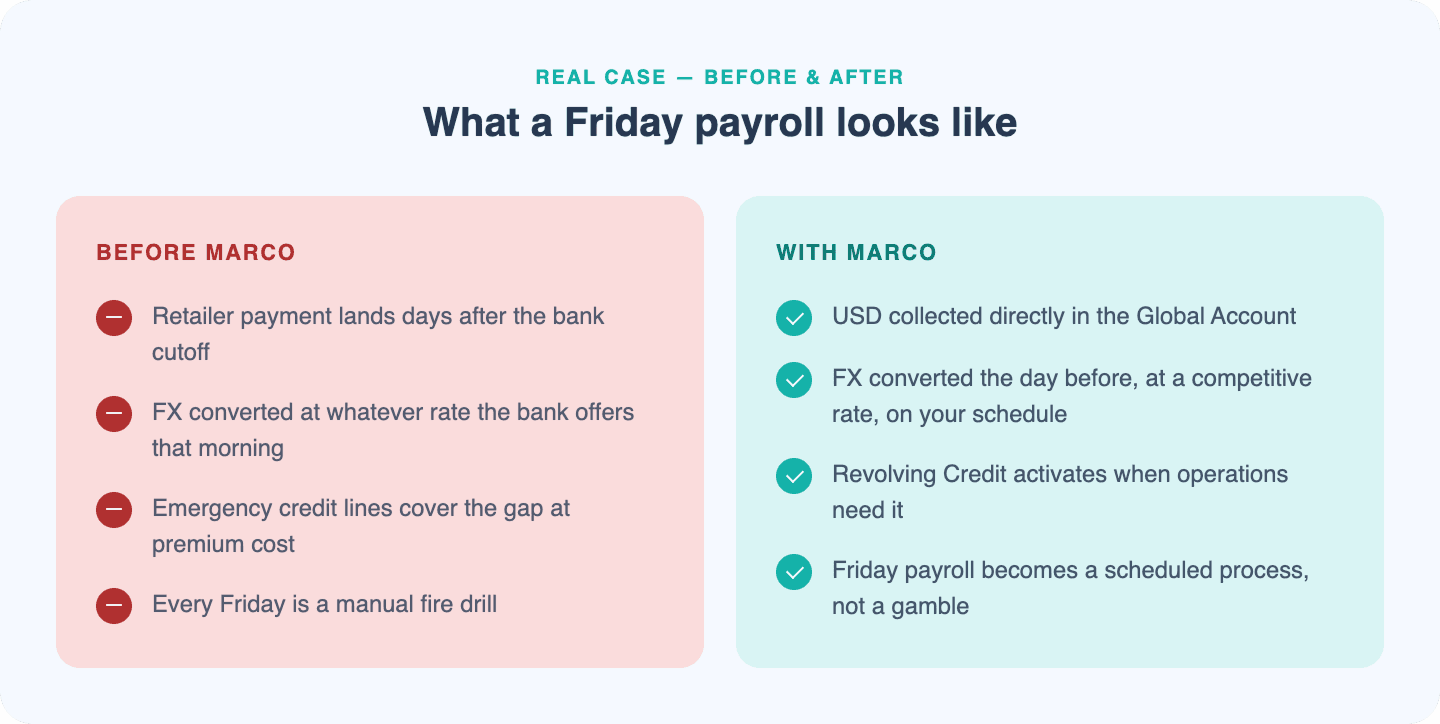
Every Friday, the finance lead faces the same question: did the funding clear in time to run payroll?
The answer depends on whether a wire from a U.S. retailer cleared that morning, whether the Mexican bank processed the incoming transfer before its cutoff, and whether the FX conversion was completed before the payroll run initiated.
On a normal week, the answer is yes — barely. On a week where a wire arrives a day late, or where the bank's processing window closes before the conversion completes, the answer can be no. And in agricultural operations, a delayed payroll doesn't produce a complaint. It stops a harvest.
The Fridays are very delicate. If funding doesn't arrive on time, we can't pay field payroll — and that is extremely dangerous." — Finance Lead, produce exporter, Mexico → U.S.
This isn't a liquidity crisis. The company is profitable. The revenue is real. The problem is structural: the financial infrastructure wasn't built for the timing demands of cross-border agricultural operations.
The real cost, quantified
The financial infrastructure layer rarely enters the conversation — which is precisely why it continues to be expensive.
"In six months, their Friday payroll went from a weekly fire drill to a scheduled process. The full case is below."
What a structured cross-border operation looks like
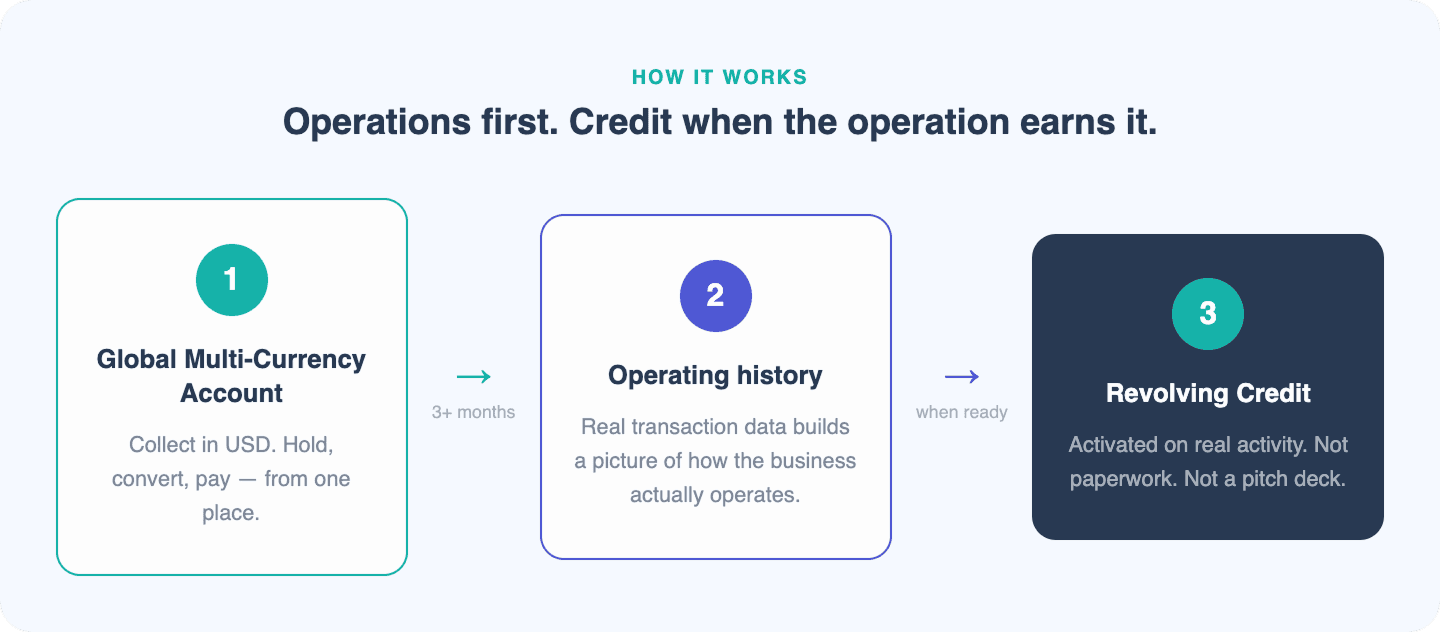
The alternative isn't complicated. It is simply designed for the actual conditions of MX→U.S. produce operations.
The category question every produce CFO should ask
The companies that have built durable financial infrastructure for cross-border operations share one characteristic: they stopped treating FX and cross-border payments as a banking problem and started treating them as an operational design problem.
The bank cutoff, the wire timing, the FX spread — these aren't facts of life. They are design choices made by institutions that weren't built for the realities of weekly agricultural payroll cycles.
The question worth asking is not: how do we manage the bank cutoff? The question is: why does our payroll depend on a bank cutoff at all?
See how one produce exporter answered that question
A berry and vegetable exporter with USD 12M in annual sales — supplying Costco, Whole Foods, Sprouts, and other top-tier U.S. retailers — restructured their cross-border financial operations using a Global Multi-Currency Account and, after establishing operating history, a Revolving Credit Line.
In the first six months: transactions on the platform grew from 9 to 217 per month. Monthly FX volume exceeded USD 1.4 million. And the Friday payroll question went from a weekly fire drill to a scheduled process.
The full case is available below.
Artículo escrito por
Federico Peselewitz | Director of Risk

Opera entre Latinoamérica y EE.UU. desde un solo lugar.
Cuenta Global · FX · Pagos · Crédito